For the Planet
For the Planet
Choosing a plant based diet and going vegan can greatly benefit the environment due to the incredibly large impact that animal products have on the planet.
Climate Impact
Factory farming and the production of animal-based foods result in a vast amount of emissions that worsen climate change, destabilize ecosystems, and threaten the existence of both humans and animals as species on this planet. Animal agriculture accounts for 18% of global greenhouse gas emissions—more than the entire transport sector combined (Steinfeld et al. 2006). The meat and dairy industries are responsible for up to 50% of GHG emissions related to food production (Holdier 2016). Globally, livestock farming is one of the largest sources of GHG emissions, contributing 18–20% of emissions in both Europe and the USA (Holdier 2016). For instance, a single cow emits more methane and ammonia than some small cars (Holdier 2016). Plant-based diets such as veganism can reduce one’s climate footprint by up to 75% compared to a diet including meat (Scarborough et al. 2023). Additionally, a plant-based diet can reduce land use by up to 75% and water use by 54% in food production.
Resource Use
Various types of animal-based foods like meat, eggs, and dairy require vast amounts of resources and constitute an extremely inefficient use of land, crops, and water. This inefficiency becomes clear when considering that a piece of beef requires the animal to be raised and fed for approximately 18 months before slaughter. Only after slaughter can one retrieve the resources invested in the animal’s upbringing. This can be calculated using what's called feed conversion efficiency—the ratio of calories fed to an animal to the calories returned in the final meat product. Beef production requires roughly 10 times more calories in feed than it yields, pork requires 5 times more, and chicken 2.5 times more (Smil 2002). This feed is often soy, which could have been used much more efficiently if consumed directly by humans—in a 1:1 ratio. Today, up to 80% of the world’s soy is fed to animals (WWF 2020).
Only 48% of crops grown globally are consumed directly by humans, while 41% go to animal feed and 11% to biofuels (Ritchie 2021). According to WHO, 733 million people—roughly 1 in 11—suffered from hunger in 2023 (WHO 2024). This means that if the calories currently fed to livestock were redirected to human consumption, world hunger could be eliminated and beyond. Raising animals for food is therefore an extremely inefficient method of resource use compared to the production of plant-based foods.
Water
Up to 92% of the world's freshwater is used in agriculture, and one-third of this is allocated to livestock farming (Mekonnen & Hoekstra 2011). Producing pork requires twice as much water as producing the same caloric amount of legumes, and four times more than grains (Mekonnen & Hoekstra 2011).
Here are some average figures for the water required to produce 100g of the following foods:
(Mekonnen & Hoekstra 2011)
- Beef – 1540 liters
- Pork – 480 liters
- Farmed fish – 550 liters
- Chicken – 390 liters
- Peanuts – 287 liters
- Chickpeas – 276 liters
- Soybeans – 244 liters
- Tofu – 214 liters
- Lentils – 50 liters
Water is typically divided into green, blue, and grey water. Green water is rainwater stored in soil and absorbed by plants. As it comes directly from precipitation, it is considered a more sustainable source. The above figures include green water used for crops grown for livestock feed. Blue water refers to surface and groundwater used in irrigation. Grey water is the volume needed to dilute pollutants to meet environmental standards and is often used in processes that contaminate water—such as nitrogen fertilizer runoff or livestock waste. Based on these distinctions, water footprints can be further broken down:
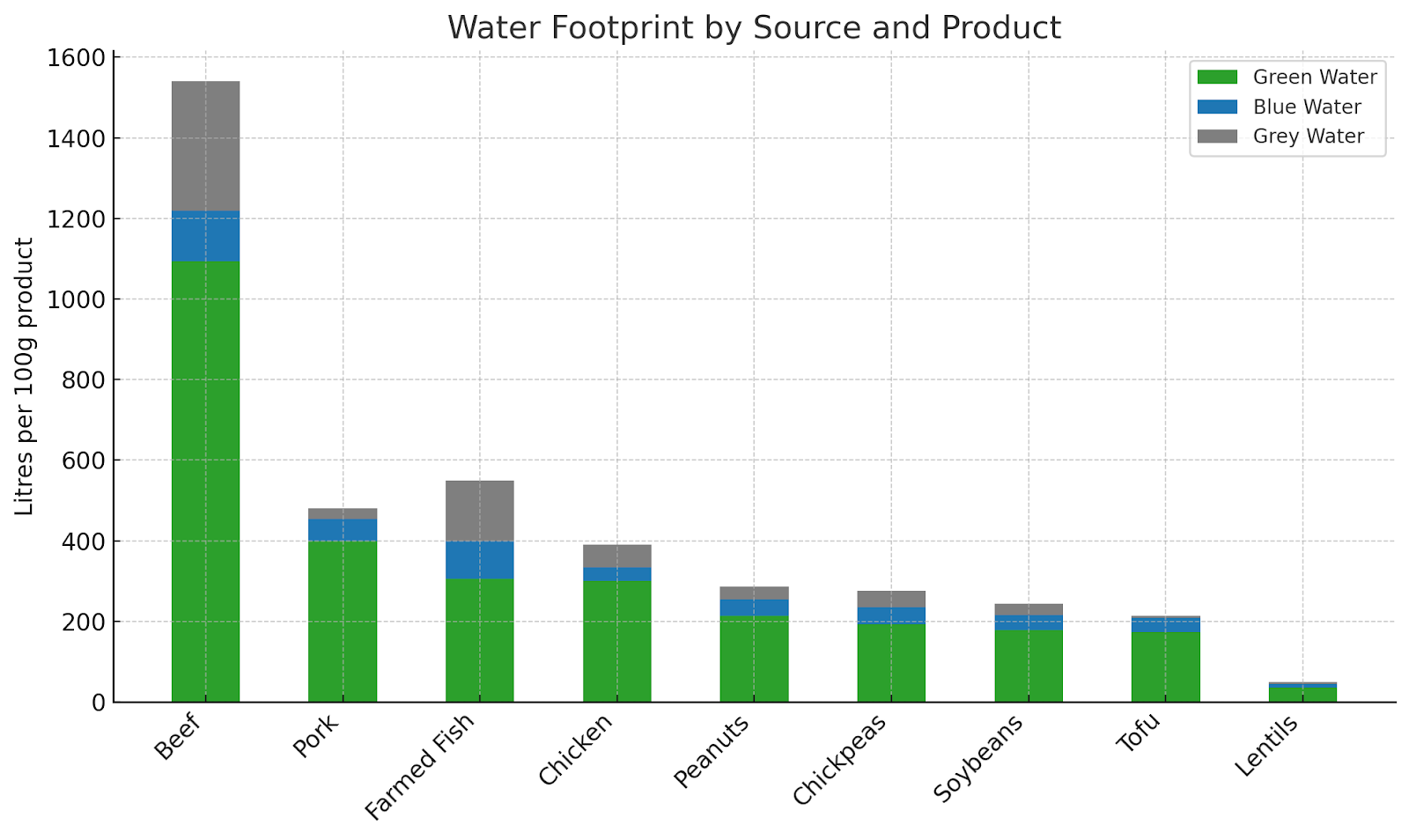
All types of food production use a significant amount of green water, but animal agriculture’s share is particularly high due to the feed crops included. This highlights an inefficient allocation of water and food resources. Regardless of the water type—green, blue, or grey—a high water footprint has serious environmental implications. Animal products often require many times more water than their plant-based alternatives. For example, beef requires three times more water than lentils for the same amount of food, while pork and chicken require hundreds of times more water than tofu or chickpeas.
Environmental Pollution
Animal agriculture causes numerous forms of environmental pollution, including waterway contamination, eutrophication (nutrient overloading in aquatic systems), air pollution (ammonia, particulate matter), GHG emissions (especially methane and nitrous oxide), biodiversity loss due to land degradation, higher risks of zoonotic diseases (transmitted between animals and humans), antibiotic resistance, and soil contamination from pesticides and heavy metals.
Waterways and Disease
In the EU, 38% of freshwater bodies are affected by agricultural runoff, while agriculture is the leading cause of water pollution in rivers and streams in the U.S. (FAO). Concentrated Animal Feeding Operations (CAFOs), or factory farms, manage roughly 22 kg of animal waste per day per farm (Schlosser 2001). In the U.S. there are rougly 21 000 CAFOs in operation, which means they together create 462 000 kg of waste every day. The U.S. industry standard is to store waste in large “lagoons” until it is repurposed as fertilizer. These lagoons foster harmful bacteria and disease-carrying microbes (Schlosser 2001). Pathogens like salmonella and E. coli spread through air, water, or direct contact (Zamir et al. 2022).
Eutrophication and Algal Blooms
Due to nitrogen and phosphorus runoff from fertilizers, the Baltic Sea is one of the world’s most eutrophied marine areas (HELCOM 2023). In summer, toxic cyanobacteria blooms block sunlight from reaching underwater vegetation (HELCOM 2024). When algae sink, oxygen levels drop further, creating “dead zones” where aquatic life cannot survive (Giagini & Lazzaroni 2018).
Fish farms in the Baltic also release nutrients through fish waste and uneaten feed. One medium-sized facility can produce emissions equivalent to thousands of hectares of farmland (Murray et al. 2019). Trawling and overfishing release nutrients that worsen phosphorus levels and kill off organisms essential for breaking down organic material (Bradshaw et al. 2021). Additionally, the fishing industry contributes to plastic pollution—WWF estimates there are nearly 800 tons of abandoned fishing gear on the Baltic seabed (WWF 2015). These degrade into microplastics that bioaccumulate up the food chain, including in fish eaten by humans (Alberghini et al. 2022), with significant effects on human health (Swedish Food Agency 2024).
Agriculture
Agriculture as a whole is a major contributor to climate change, but the most problematic aspect is the resource-intensive and inefficient nature of animal production. While agricultural methods need improvement, real change begins with shifting toward a plant-based food system. Animal farming releases large amounts of ammonia, contributing to acidification and eutrophication of sensitive ecosystems. Around 81% of global ammonia emissions originate from agriculture—mainly from manure management and grazing land (Wyer et al. 2022). Ammonia forms fine particles (PM₂.₅) that increase risks for heart and lung diseases. In the EU, agriculture is responsible for about 50% of these particulates (Wyer et al. 2022). Methane emissions from livestock are also a major driver of both climate change and air pollution, accounting for 32% of global methane emissions (FAO 2022).
Pesticide use in farming leaves residues that accumulate in soil. In the EU, pesticide traces have been detected on up to 74.5% of farmland (ESDAC 2024). Heavy metals like cadmium and phosphorus accumulate in the soil as well, reducing fertility and risking leaching into groundwater—and eventually our drinking water (Vieira et al. 2024). A more resource-efficient agriculture with less reliance on animal production would mitigate these risks.
Land Use
Some argue that animal farming contributes to biodiversity, but in reality, the opposite is true. Today, the massive expansion of agriculture and unsustainable land use are the leading causes of biodiversity loss worldwide (UN 2021). Half of the world’s ice-free and desert-free land is used for agriculture, most of it either as pasture or to grow animal feed (Ritchie 2021).
Cattle farming is responsible for 80% of global deforestation (Nepstad et al. 2009). This process emits 340 million tonnes of CO₂ annually, around 3.4% of global emissions (WWF 2008). A large portion of deforestation occurs in the Amazon—the world’s largest rainforest and home to tens of thousands of species (Lewinsohn & Prado 2005). The problem is not soy consumed by vegans, but the soy used for animal feed—which accounts for 77% of global soy production (Ritchie 2024). In Brazil, expanding soy plantations have been a major driver of deforestation. Combined with land cleared for feedlots and grazing, the livestock sector’s total impact on the Amazon is immense. Up to 10,000 species in the Amazon are currently at risk of extinction (Nobre et al. 2021).
According to the UN, changing our diets is essential to restoring ecosystems and easing the strain on the planet. The rising consumption of animal products is directly linked to the expansion of land for animal agriculture. This trend must be reversed to prevent further damage. By choosing plant-based foods over animal products, you help protect biodiversity, preserve rainforests, and reduce global emissions.
Sources
Alberghini, L., Pavoni, E., Nisi, R., Zampetti, G., Spanò, M., Girolimetti, S., & Minucci, A. (2022). Micro and nanoplastics in food: An emerging threat to human health. Microplastics and Nanoplastics, 2(1). https://doi.org/10.1186/s43591-022-00036-9
Bradshaw, C., Almroth-Rosell, E., Båmstedt, U., et al. (2021). Eutrophication in the Baltic Sea: Knowledge base prepared for the Swedish Environmental Objectives Committee. Stockholm: Havsmiljöinstitutet.
ESDAC (2024). Pesticides in EU Soils. European Commission. https://esdac.jrc.ec.europa.eu/public_path/shared_folder/doc_pub/EUSO/EUSO_PEST.pdf
FAO (2022). Global methane assessment: 2030 Baseline Report. Food and Agriculture Organization of the United Nations. https://www.fao.org/3/cc8175en/cc8175en.pdf
FAO (n.d.). Water pollution from agriculture: A global review. Food and Agriculture Organization of the United Nations. https://www.fao.org/3/i7754e/i7754e.pdf
Giagini, E., & Lazzaroni, M. (2018). Algal bloom. In M. Ferrante & A. Fulantelli (Eds.), Science and Technology Education. Springer. https://doi.org/10.1007/978-3-319-71054-9_63
HELCOM (2023). The State of the Baltic Sea – Second HELCOM holistic assessment 2016–2021. https://helcom.fi/wp-content/uploads/2023/12/Baltic-Sea-Environment-Proceedings-No.-186.pdf
HELCOM (2024). Algal bloom index. https://indicators.helcom.fi/indicator/algal-bloom-index/
Holdier, A. (2016). The environmental costs of animal agriculture. The Prindle Post. https://www.prindlepost.org/2016/11/environmental-costs-animal-agriculture/
Lewinsohn, T. M., & Prado, P. I. (2005). How many species are there in Brazil? Conservation Biology, 19(3), 619–624. https://doi.org/10.1111/j.1523-1739.2005.00680.x
Mekonnen, M. M., & Hoekstra, A. Y. (2011). The green, blue and grey water footprint of farm animals and animal products. UNESCO-IHE Institute for Water Education. https://waterfootprint.org/media/downloads/Report-48-WaterFootprint-AnimalProducts-Vol1.pdf
Murray, A. G., et al. (2019). Mitigating the impacts of salmon aquaculture on the marine environment. In The Welfare of Fish. Springer.
Nepstad, D. C., Stickler, C. M., Soares-Filho, B., & Merry, F. (2009). Interactions among Amazon land use, forests and climate: Prospects for a near-term forest tipping point. Philosophical Transactions of the Royal Society B: Biological Sciences, 363(1498), 1737–1746. https://doi.org/10.1098/rstb.2007.0036
Nobre, C. A., Sampaio, G., Borma, L. D. S., et al. (2021). Land-use and climate change risks in the Amazon and the need of a novel sustainable development paradigm. Proceedings of the National Academy of Sciences, 118(40), e2101551118. https://doi.org/10.1073/pnas.2101551118
Ritchie, H. (2021). How much of the world’s cropland is used to grow food for people? Our World in Data. https://ourworldindata.org/cropland-use-food
Ritchie, H. (2024). Soy: Environmental impact and where it is grown. Our World in Data. https://ourworldindata.org/soy-environmental-impact
Scarborough, P., et al. (2023). The environmental impact of diets in the UK. Nature Food, 4, 749–757. https://doi.org/10.1038/s43016-023-00898-w
Schlosser, E. (2001). Fast Food Nation: The Dark Side of the All-American Meal. Houghton Mifflin Harcourt.
Serafini, M. (2019). The role of red meat in the diet: Nutrition, health, and environmental sustainability. Meat Science, 162, 108025.
Smil, V. (2002). Eating meat: Evolution, patterns, and consequences. Population and Development Review, 28(4), 599–639. https://doi.org/10.1111/j.1728-4457.2002.00599.x
Steinfeld, H., Gerber, P., Wassenaar, T., Castel, V., Rosales, M., & de Haan, C. (2006). Livestock’s Long Shadow: Environmental Issues and Options. FAO. https://www.fao.org/3/a0701e/a0701e.pdf
Swedish Food Agency (Livsmedelsverket) (2024). Microplastics in food. https://www.livsmedelsverket.se/livsmedel-och-innehall/miljo-och-hallbarhet/mikroplaster
UN (2021). State of the World’s Forests 2020: Forests, biodiversity and people. Food and Agriculture Organization of the United Nations. https://www.fao.org/documents/card/en/c/ca8642en
Vieira, C., Morais, S., Ramos, S., Delerue-Matos, C., & Oliveira, M. B. P. P. (2024). Heavy metals in agricultural soils: Sources, effects and remediation strategies. Environmental Pollution, 346, 122671. https://doi.org/10.1016/j.envpol.2023.122671
WHO (2024). Hunger and food insecurity. World Health Organization. https://www.who.int/news-room/fact-sheets/detail/hunger-and-food-insecurity
WWF (2008). Emissions from deforestation and forest degradation. https://wwfint.awsassets.panda.org/downloads/emissions_from_deforestation_and_forest_degradation.pdf
WWF (2015). Fishing gear in the Baltic Sea: Abandoned, lost or otherwise discarded fishing gear. https://wwf.se/app/uploads/2021/06/fishing-gear-in-the-baltic-sea_wwf-report.pdf
WWF (2020). Soy: Feed for the animals in our barns. https://www.wwf.se/djur/soy/
Wyer, M. et al. (2022). Ammonia pollution from agriculture. European Environment Agency. https://www.eea.europa.eu/en/analysis/indicators/ammonia-pollution-from-agriculture-3