Ethics
Ethics
The consumption of animals is ethically problematic because it is based on the exploitation of sentient beings for our own benefit, particularly as animals have no influence over their living conditions. Unlike in the past, we now have plenty of plant-based alternatives that fully meet our nutritional needs – so why do we continue eating meat? Usually, this can be traced to deeply rooted traditions tied to culture, taste, and habits. Many people regard meat consumption as a normal and necessary way of life, reinforced by the fact that the meat industry meets demand with cheap and accessible products. However, taking a life purely for the sake of our own pleasure raises a moral dilemma. Additionally, the meat industry is a major contributor to climate change, making our dietary choices a matter of both responsibility and ethics. By questioning ingrained habits, we can pave the way for a more sustainable and compassionate lifestyle.
Could you eat a dog – or even a cat? For many, that thought evokes strong discomfort, and most people would probably answer no, since dogs and cats are considered “man’s best friend,” right? “Speciesism” is a term with multiple definitions, some broader than others, but it generally refers to the discrimination humans exercise against other species (Ryder 2012). Eating pigs, cows, or chickens while abstaining from cats, dogs, and other companion animals is a striking example of speciesism. The term was coined in 1971 by psychologist Richard Ryder, who argued for “equality across species boundaries.” He also compared the concept to racism and sexism – that is, discrimination based on skin color and gender (Ryder 2012).
Three ethical positions emerged in opposition to speciesism: utilitarianism, rights theory, and painism. The utilitarian opposition to speciesism has been led by Peter Singer, who popularized the term in his 1975 book Animal Liberation. Utilitarianism is a moral theory that claims an action is justified if it maximizes overall happiness for everyone affected. Singer pointed out, for instance, that hens have preferences for certain environments, which can be measured. As early as 1789, Jeremy Bentham argued that the question is not “can they reason?” but “can they suffer?” Rights theory is associated with modern philosopher Tom Regan, who argued that animals have basic rights that must be respected regardless of the consequences for others. The third position, painism, was developed by Richard Ryder himself. Painism is based on the idea that the only morally relevant trait is the capacity to feel pain, whether physical, emotional, or cognitive: “all beings who feel pain deserve rights.” Painism merges the utilitarian concern for suffering with the rights-based respect for the individual, but does not permit the happiness of many to justify the suffering of one. Painism holds that the morally right decision is always the one that reduces suffering the most – not the one that benefits the greatest number (Ryder 2012).
Examples of speciesism include slaughter, fishing, egg and dairy production, fur farming, live animal transport, painful animal experiments, selective breeding for genetic defects, surgical mutilations, the use of animal organs in transplants, animals used in education, behavioral experiments, zoos, captivity, all forms of animal-based entertainment (such as rodeos or horse racing), the use of snares and traps, and the trade in wild animals – and much more. None of these forms of exploitation would be acceptable if directed at humans in today’s society. The fact that these practices are still tolerated indicates a widespread and institutionalized form of speciesism.
Zoocentric, Biocentric, and Anthropocentric Argumentation
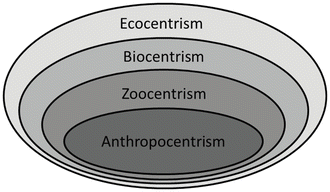
The reasons people choose to abstain from consuming animals or animal products can be categorized into three types of argumentation: biocentric, zoocentric, and anthropocentric (Vinnari 2010). The biocentric perspective emphasizes that every living organism – from microorganisms to plants and animals – possesses intrinsic value simply by being alive. The goal is to minimize harm to all forms of life, even if plants or microbes do not experience conscious pain in the same way that animals and humans do. In today’s environmental debate, veganism is often linked to animal rights, primarily because animal-based food production requires significantly more resources than plant-based alternatives. As a result, many people adopt veganism from a biocentric standpoint, focusing on reducing the environmental impact of large-scale animal farming (Högback 2024: 81).
There is also a fourth and more overarching category: ecocentrism. Ecocentrism emphasizes the interconnectedness of nature – animals, plants, the environment, and ecosystem functionality – and the importance of maintaining balance among these parts. An ecocentric approach to veganism may involve abstaining from animal products to protect the environment, preserve biodiversity, and combat climate change. The zoocentric view centers on animals and recognizes that they have moral value equal to that of humans. Since animals can feel pain, we should avoid actions – particularly the consumption of meat and other animal products – that cause them unnecessary suffering. Peter Singer, an early advocate of the animal rights movement, highlights utilitarianism as a key argument within animal ethics (Högback 2024: 80–81).
The anthropocentric view places human interests and well-being as the primary moral concern. Examples include promoting veganism for its health benefits, reduced environmental impact, and increased sustainability. While these outcomes are certainly positive, this line of reasoning focuses primarily on what benefits humans, while the rights of animals are treated as secondary. Transitioning to a vegan diet, for instance, may be motivated by the fact that the animal industry worsens climate change, thereby threatening the future of humankind (Högback 2024: 81–82).
Intersectionality
A. Breeze Harper is a prominent scholar who has shown that avoiding animal products does not automatically mean one is free from other forms of oppression. The form of veganism that highlights issues of racism and social injustice is known as intersectional veganism. This means that different forms of oppression should be seen as interconnected, rather than as separate entities. Harper argues that animal rights activism must extend beyond animal welfare and that veganism must be part of a broader social commitment to justice (Harper 2013).
However, Harper warns against the idea that veganism alone solves social injustices. On the contrary, veganism can sometimes contribute to obscuring or even reinforcing other forms of oppression. One example is when veganism is portrayed as a lifestyle for white, affluent individuals, which can lead to cultural appropriation or criticism of Indigenous and non-Western food traditions. Plant-based diets have long been part of cultures in, for example, the Middle East and Asia, and portraying veganism as “white” risks erasing these histories (Giraud 2021: 113–114). Animal rights activism should respectfully align with the struggle against other forms of oppression. These forms of oppression are viewed as interacting rather than comparable, which requires a solidarity that is attentive to historical contexts and power dynamics (Giraud 2021: 106). The aim is not to diminish others’ suffering, even though such comparisons might be interpreted that way.
Scholar Aph Ko uses the term “multidimensional oppression” and emphasizes that systems of racism, sexism, classism, and speciesism are not only connected – they also generate each other (Ko 2021). Ko further develops the idea of intersectionality into what she calls multidimensional liberation theory. She argues that how we understand a problem shapes what kinds of solutions we consider viable. If we treat oppression as isolated and two-dimensional – even within intersectional contexts – we will end up with two-dimensional solutions that fail to address the root of the issue (Ko 2021: 89–91). Conversely, if we understand oppression as a complex, multidimensional structure, our solutions will also become more holistic and effective.
Activists with a two-dimensional view of the system see a two-dimensional house with only a front door – their only point of entry. They perceive multiple individual houses, each representing a form of oppression that must be dismantled, meaning they must divide their energy across all of them. This often results in burnout, and many eventually choose to focus on a single group to conserve energy (Ko 2021: 91). Activists with a multidimensional understanding see a house with multiple entry points – a side door, a back door, perhaps a skylight. These individuals see beyond the obvious front door and understand that oppression is upheld by various social factors and actors. These can be challenged from different angles or access points, since all forms of oppression are interconnected and require multifaceted strategies (Ko 2021: 92).
Sources
Giraud, Eva (2021) Veganism: politics, practice and theory. London: Bloomsbury
Harper, Armie Louise (2013) Vegan Consciousness and the Commodity Chain: On the Neoliberal, Afrocentric, and Decolonial Politics of “Cruelty-Free”. ProQuest LLC. Ann Arbor
Högback, Freja (2024) Veganism – ensakspolitik eller komplex vardagspolitik. Finsk Tidskrift, pp. 79–93
Ko, Aph (2021) Racism as zoological witchcraft: A guide to getting out. Brooklyn, NY: Lantern Books
Ryder, Richard (2012) Speciesism. Encyclopedia of Applied Ethics (2nd ed.), pp. 213–219
Vinnari, Markus (2010) Past, Present and Future of Eating Meat in Finland. Turku: Uniprint